Skip to searchSkip to main content

​Data Center Temperature and Humidity Monitoring Solutions

Keeping a data center online isn’t just about redundant power and network paths—it’s about holding temperature, humidity, and dew point inside a very tight window, 24/7. Small deviations can shorten server life, trigger thermal throttling, or even cause shutdowns. At the same time, energy costs demand that you run your cooling systems as efficiently as possible.

Moore Industries’ high-accuracy temperature, humidity, and dew point assemblies were originally designed for high-tech environments like semiconductor fabs and biotech facilities. Those same strengths—precision, stability, and robust construction—make them a natural fit for modern data centers and mission-critical IT spaces.

Contact us for application assistance!
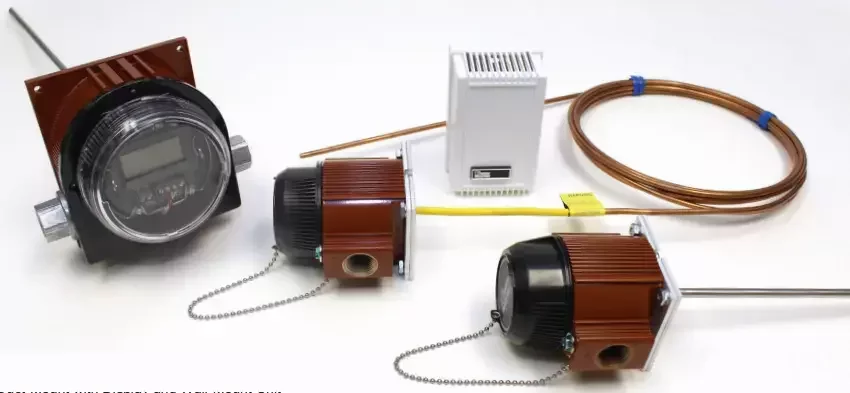
Data center temperature and humidity monitoring sensors
Temperature and humidity monitoring instrumentation for data centers

👉 Schedule a free on-site consultation with Clipper Controls to discuss temperature, humidity, and dew point in your data center.


Need service for your sensors or transmitters? Message our Service Team or call us at (844) 880-2469.


Explore related pages: Gas, Flame & Leak Detectors, Calibration Service, Field Services, Analyzers, Equipment Shelters, Process Control Applications

​Why precision environmental monitoring matters in data centers

Data centers operate with dense heat loads and strict service-level expectations. To manage that risk, operators need reliable sensing in critical air paths (underfloor, overhead, hot and cold aisles), accurate temperature, humidity, and dew point feedback to CRAH/CRAC units and BMS controls, and long-term stability to avoid drift, nuisance alarms, and frequent recalibration.

Moore Industries’ approach is to deliver “total system” accuracy by pairing intelligent transmitters with precision 4-wire platinum RTDs and optimized calibration. That combination gives operators very low uncertainty from sensor tip all the way to the control system input, which supports tighter control bands and more confident decision-making.

​From clean room to data hall: technology built for tight tolerances

High-tech facilities such as semiconductor and pharmaceutical plants rely on this technology to keep temperature, humidity and dew point tightly controlled in air handling systems, chillers, and clean-room ductwork. Data centers face similar demands for stability and uptime, making these assemblies a strong fit for:
  • Hyperscale and colocation data halls
  • Edge and micro-data centers
  • Network rooms, control rooms, and support spaces
Because the solutions are built for environments where fractions of a degree matter, they’re well suited to data centers that want to run closer to upper temperature limits for better energy efficiency—without sacrificing reliability.

In practice, that means bringing clean-room–grade measurement performance into places like rooftop AHUs, CRAH/CRAC units, and data hall supply ducts. When your humidity and dew-point sensors respond quickly and hold their calibration, the BMS can make smaller, more confident adjustments instead of constantly “chasing” setpoints. The result is steadier inlet conditions at the rack, fewer nuisance alarms, and more freedom to optimize chiller setpoints, economizer hours, and humidification without worrying that a bad reading is steering you into a risky operating zone.

These assemblies are also engineered for long-term stability and serviceability, not just initial accuracy. Rugged housings, proper probe placement, and options like remote sensors or sampling lines help keep sensitive elements out of harsh spots while still capturing representative conditions. Combined with traceable factory calibration and straightforward field checks, that gives operations teams confidence that what they see on the dashboard reflects what’s really happening in the data hall, not sensor drift or noise.
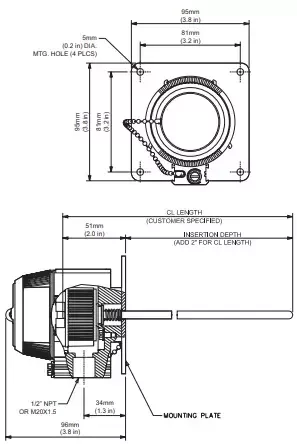
Duct-mount high-precision temperature assembly for clean rooms and small air ducts
Illustration of Duct-mount temp assembly

​Averaging duct sensors for accurate CRAH and AHU control

In large air handlers and supply plenums, a single point sensor often doesn’t tell the whole story; stratification can trick controls into over- or under-cooling. Moore Industries addresses this with a flexible averaging RTD sensor that acts as one continuous sensing element rather than multiple discrete RTDs wired in series.

For data center use, this design brings several important benefits:
  • The sensing element runs along a long sheath (typical lengths like 300 or 480 inches), measuring temperature along its full length to deliver a genuine cross-sectional average—ideal across coil faces and large duct sections feeding a data hall.
  • System accuracy over common HVAC ranges (for example –20 to 40°C) is tight enough to support precise supply-air control aligned with ASHRAE guidelines.
  • A NEMA 4X/IP66 connection head and 4–20 mA loop-powered transmitter withstand mechanical rooms and plenums while making integration with a BMS or PLC straightforward.

By feeding more representative air-temperature data back to your CRAH or AHU controllers, averaging sensors support both reliable cooling and optimized fan and chiller energy use.

👉  Want clean-room–grade accuracy in your AHUs and CRAHs? Talk with Clipper Controls about Moore Industries temperature, humidity, and dew point assemblies that bring that level of precision into your data center.
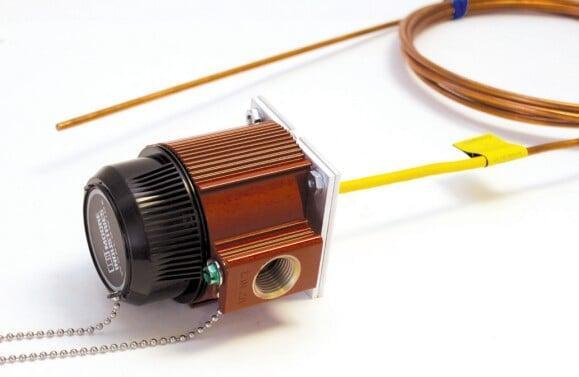
Flexible Air Duct Averaging Temperature Sensor
Illustration of Flexible Air Duct Averaging Temperature Sensor

​Duct-mount sensors for branch ducts, cold aisles, and small spaces
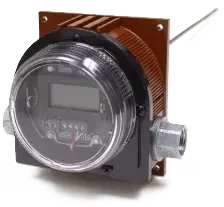
Not every air path calls for an averaging element. In smaller ducts, branches, or local zones—like cold aisles, containment inlets, or underfloor feeds—straight duct-mount temperature assemblies provide accurate point measurements.

These assemblies pair a high-accuracy Class A platinum RTD with loop-powered transmitters that can be configured via PC software or HART/DTM tools. With the high-accuracy calibration option, total system accuracy across typical HVAC spans can be extremely tight, supporting narrow deadbands and stable control.

For maintenance teams, the optional two-plate mounting design allows the sensor housing to be removed with wing nuts while the base plate stays fixed to the duct. That avoids enlarging duct holes over repeated calibrations or replacements—a practical benefit in crowded mechanical rooms and ceiling spaces.
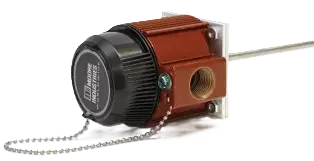
Duct-mount temperature, humidity, and dew point assembly with clear coat housing

​Wall-mount room air temperature monitoring

Many data center campuses include supporting spaces—network closets, control rooms, staging areas, and office zones—that still need reliable environmental control. For these locations, low-profile wall-mount room air temperature monitors use the same high-accuracy RTD technology as the duct assemblies.

They provide:
  • Tight system accuracy over common room ranges (for example 10 to 40°C)
  • Loop-powered 4–20 mA outputs for simple integration with BMS and DCIM platforms
  • A subtle surface-mount enclosure that looks appropriate in finished interiors while still providing industrial-grade performance behind the scenes

This gives operators end-to-end visibility from the white space to the support areas that keep it running.

👉 Planning cold aisle containment or branch duct upgrades? Call Clipper Controls at (844) 880-2469 and we’ll help you choose duct-mount and point sensors that give complete coverage without overcomplicating the install.
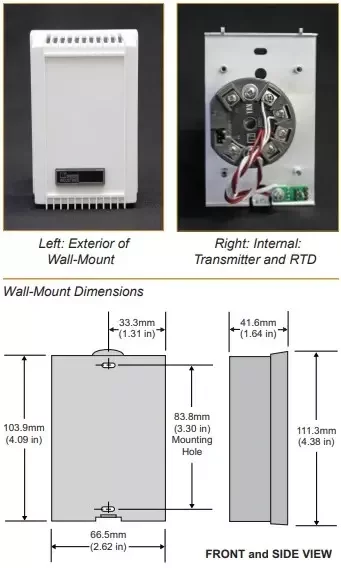
Wall-mount low-profile data center air temperature monitor
Wall-mount data center room temperature transmitter

​Humidity and dew point monitoring with smart HART® transmitters

Temperature is only half the story in a data center. Too dry and you risk electrostatic discharge; too humid and you invite condensation and corrosion. Dew point is particularly important near chilled-water piping, coils, and in high-density cold aisles.

Smart HART® humidity, temperature, and dew point transmitters are designed for demanding HVAC and industrial environments and are a strong match for data center applications. A single device measures relative humidity and temperature and calculates dew point, so you can trend all three from one installation.

Key advantages for data center engineers include:

  • Dual isolated, scalable 4–20 mA outputs that you can assign to RH, temperature, or dew point in whatever combination your control strategy requires.
  • Very low system uncertainty with high-accuracy calibration over a wide temperature range, enabling close humidity control.
  • Robust housings, stainless-steel probes and thermowells, and industrial-grade components suited for mechanical rooms, coil sections, and mixing boxes.

With one instrument, you can monitor and control to temperature, RH, and dew point setpoints aligned with ASHRAE recommendations and your own internal standards.

👉  Curious how RH and dew point control could reduce risk in your white space and mechanical rooms? Contact Clipper Controls to review humidity and dew point transmitter options for your data center.

​Calibration strategies for uptime and compliance

In critical facilities, sensor accuracy isn’t just a nice-to-have—it’s an operational requirement. Moore Industries offers two complementary factory calibration approaches that help ensure the entire measurement chain performs as expected.

​Standard factory calibration

For many HVAC and data center applications, standard factory calibration is sufficient. The transmitter is trimmed at the zero and span values you specify using a precise simulated sensor input, and each system ships with test data that can be used for documentation and maintenance planning.
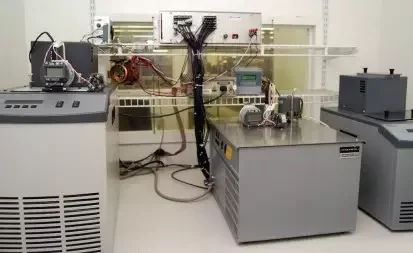
Factory bath calibration for high-accuracy data center temperature sensors

​High-accuracy bath calibration

When you need the best possible accuracy—such as validating a new cold-aisle containment design or feeding high-resolution energy models—a high-accuracy “bath calibration” option pairs the actual sensor and transmitter in a precision calibration bath.

In this process, the sensor is immersed in a stable bath, and the transmitter is trimmed to the sensor’s true output at selected temperature points. Because you choose trim points around your operating range, you can “center” the best accuracy exactly where your data center runs most of the time. The result is fewer field adjustments, more confidence in trending data, and an easier path to meeting internal audit, SLA, or regulatory requirements.

​Flexible sensors for process cooling loops and retrofits

Many data centers use chilled-water or glycol loops to feed CRAH coils, in-row coolers, or rear-door heat exchangers. Adding or upgrading sensors in these systems can be tricky if straight probes require disassembling thermowells and enclosures.

Flexible WORM®-style sensors are designed to solve that problem. Instead of a rigid probe, a flexible element bends through the conduit opening and slides into the thermowell without removing the connection head or other assembly components.

This approach allows you to:

  • Use a single flexible sensor design that can be trimmed to length to fit multiple thermowell depths and styles, simplifying spares inventory.
  • Replace or inspect the sensor quickly during planned outages or service windows.
  • Maintain high-accuracy RTD performance on critical process temperatures like chilled-water supply and return.

For retrofits in crowded mechanical rooms or on live systems where you want to avoid opening process connections unnecessarily, this flexibility is especially valuable.

​Ready-to-install assemblies streamline projects

Engineering and field crews don’t always have time to piece together transmitters, sensors, thermowells, and mounting hardware from scratch. To speed deployments, ready-to-install temperature transmitter assemblies cover the most common needs: straight thermowells, surface-mount configurations, and flexible sensors.

These assemblies guide you through selecting exactly what you need—from transmitter model to thermowell style—and arrive configured, calibrated, and ready to mount. That reduces design effort, purchasing complexity, and on-site assembly time, helping data center projects move from concept to commissioning faster.

​Best practices for deploying temperature and humidity monitoring in data centers

Every facility is unique, but a few patterns show up again and again when designing data center environmental monitoring:

Start by mapping your critical zones: cold aisles, hot aisles, underfloor or overhead distribution paths, mechanical rooms, and support spaces. Place sensors where they represent what IT equipment actually “feels,” not just where it’s convenient to mount them. Combining averaging RTDs across coil faces and large plenums with point sensors in aisles, branches, and smaller rooms gives controls both the big picture and local detail.

Whenever possible, pair temperature with humidity and dew point, particularly near coil sections and piping where condensation is a risk, and in white space where static control matters. Align calibration and verification practices with risk: use high-accuracy calibration and more frequent checks in the most critical locations, while allowing standard calibration in secondary spaces.

Designing your sensing strategy up front—rather than treating sensors as an afterthought—pays off in uptime, energy savings, and clearer diagnostics when something goes wrong.

​Plan your next data center monitoring upgrade

Whether you’re building a new facility or tuning an existing one, the right combination of sensors and transmitters can make your cooling plant smarter, your alarms more meaningful, and your energy use more predictable.

Moore Industries temperature, humidity, and dew point solutions offer:

  • High overall system accuracy and long-term stability
  • Duct, wall, process, and flexible sensor options for nearly every location
  • Factory calibration options with detailed documentation

👉  Ready to plan your next monitoring upgrade? Call Clipper Controls at: (844) 880-2469 or send us a message to discuss a data center environmental monitoring package tailored to your facilities in California, Nevada, and Hawaii.

​Work with Clipper Controls

When data center uptime is on the line, you need more than a parts catalog—you need a partner who understands instrumentation and mission-critical cooling. Clipper Controls works with data center operators, facility engineers, and contractors to design temperature, humidity, and dew point monitoring solutions that integrate cleanly with your BMS and DCIM systems.

As a manufacturer’s representative for Moore Industries and other leading brands, we help you select the right mix of averaging duct sensors, room transmitters, humidity/dew point instruments, and flexible process sensors, and deliver assemblies configured and calibrated for fast installation.

Send us a message even if you’re at an early stage of researching data center temperature and humidity monitoring. We’re an excellent resource and will be happy to help you explore options and define requirements.

Serving California, Nevada, and Hawaii.

Clipper Controls field service technician working on environmental monitoring instrumentation
Clipper Controls Logo
Moore Industries Logo