Types of Mass Flow Meters
- Process optimization – ensuring that combustion systems, chemical dosing, and fluid transport run at peak efficiency.
- Regulatory compliance – providing accurate reporting for emissions monitoring and environmental standards.
- Operational safety – helping to detect leaks, inefficiencies, or abnormal flow conditions before they escalate.
- Energy management – identifying opportunities to reduce waste, improve fuel-to-air ratios, and cut operational costs.
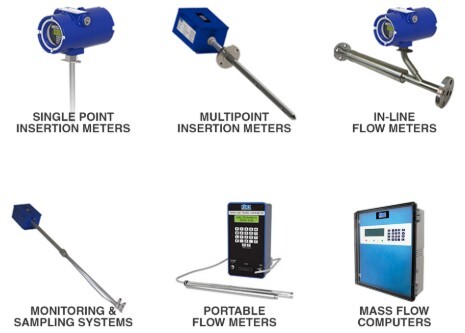
👉 View more precision flow instrumentation provided by Clipper Controls.
Single-Point Mass Flow Meters
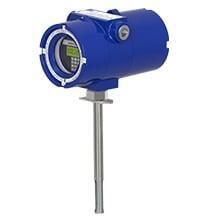
Single-point mass flow meters are designed to provide precise, localized velocity and flow readings at a specific point in a duct, pipe, or stack. These instruments are particularly effective in applications where uniform flow profiles can be assumed, or where localized data is sufficient for process optimization and compliance reporting.
For engineers and maintenance teams, the advantages of single-point meters include:
Compact design – minimal installation footprint within ducts and stacks.
High accuracy in stable conditions – ideal for controlled combustion systems or emission points.
Ease of maintenance – fewer insertion points and straightforward calibration.
Applications
Single-point mass flow meters are widely used in:
Combustion optimization – balancing air-to-fuel ratios for boilers, furnaces, and turbines.
Emissions monitoring – providing reliable data for stack gas compliance reporting.
Energy management – improving system efficiency by fine-tuning flow parameters.
Among manufacturers, Kurz Instruments’ single-point flow sensors are well regarded for their durability in harsh industrial environments. With robust thermal mass flow technology, they deliver long-term accuracy, even in high-temperature, particulate-laden stacks where lesser sensors may drift or fail. Kurz Instruments’ single-point flow sensors are well regarded for their durability in harsh industrial environments. With robust thermal mass flow technology, they deliver long-term accuracy, even in high-temperature, particulate-laden stacks where lesser sensors may drift or fail.
Multipoint Mass Flow Meters
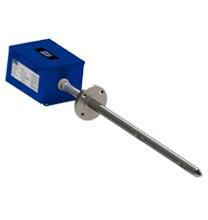
Multipoint systems deploy multiple sensing elements across the cross-section of a duct or stack, capturing a complete flow profile rather than relying on a single localized reading. This approach delivers:
Improved accuracy in large or irregular flow environments
Better representation of real conditions for reporting and compliance
Confidence in high-stakes applications like emissions monitoring and combustion optimization
Applications
- Emissions monitoring in stacks – ensuring compliance with environmental regulations by accounting for uneven velocity distributions.
- Combustion optimization – providing precise data to fine-tune air and fuel input across large boilers and furnaces.
- Energy management – offering reliable data for facilities seeking to reduce fuel use and improve efficiency.
Kurz Multipoint Technology
Kurz Instruments’ multipoint mass flow meters are engineered for high accuracy and reliability in challenging environments. Built with rugged thermal mass flow technology, they are designed to handle harsh stack conditions, including temperature extremes and particulate matter. For facilities under pressure to maintain compliance while optimizing energy use, Kurz multipoint solutions are a trusted choice.
👉 Want to learn how thermal mass flow technology can improve your operations? Contact Clipper Controls for expert guidance on selecting the right Kurz solution.
Inline Mass Flow Meters
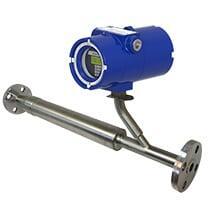
For engineers and technicians managing critical processes, inline flow meters offer:
Continuous monitoring – ideal for process streams that require uninterrupted oversight.
High accuracy and repeatability – suitable for custody transfer, chemical dosing, and quality control.
Minimal operator intervention – once installed, inline systems require little maintenance compared to portable devices.
Applications
Inline mass flow meters are widely used in:
Chemical processing – ensuring precise dosing and monitoring of feedstock.
Utilities and energy systems – measuring natural gas, steam, or compressed air consumption.
Water and wastewater systems – tracking flow rates for treatment processes and compliance reporting.
Portable Mass Flow Meters
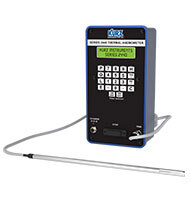
When flexibility is essential, portable mass flow meters offer a practical solution. Unlike inline systems that are permanently installed, portable units can be deployed on-demand to measure flow at multiple locations. This makes them an indispensable tool for maintenance teams, engineers, and technicians who need quick, reliable data without committing to a fixed installation.
In addition to mobility, portable mass flow meters provide a low-risk entry point for facilities considering permanent measurement solutions. By conducting short-term studies, operators can validate whether ongoing inline monitoring is necessary, compare performance across multiple systems, and prioritize capital investments. This “try before you buy” capability helps teams make informed decisions while still maintaining compliance and operational oversight.
Benefits of Portable Mass Flow Meters
- Diagnostic tool – quickly verify system performance, detect leaks, or confirm calibration of fixed instruments.
- Short-term monitoring – support temporary studies, compliance spot-checks, or troubleshooting during shutdowns.
- Cost-effective flexibility – one instrument can be moved across different systems, reducing the need for multiple fixed installations.
Applications
- Troubleshooting and audits – validating system efficiency and identifying sources of energy loss.
- Environmental surveys – monitoring stack gases or facility emissions on a temporary basis.
- Maintenance checks – verifying the accuracy of inline or multipoint systems in the field.
Why Portable Meters Complement Inline Systems
Portable meters are not meant to replace permanent measurement solutions. Instead, they provide supplemental flexibility, enabling engineers to perform spot checks, validate data, and address immediate issues. Together with inline and multipoint meters, they help build a comprehensive flow measurement strategy that balances permanence with adaptability.
👉 Implement best practices with confidence—get expert field support for installation from Clipper Controls.
Mass Flow Computers
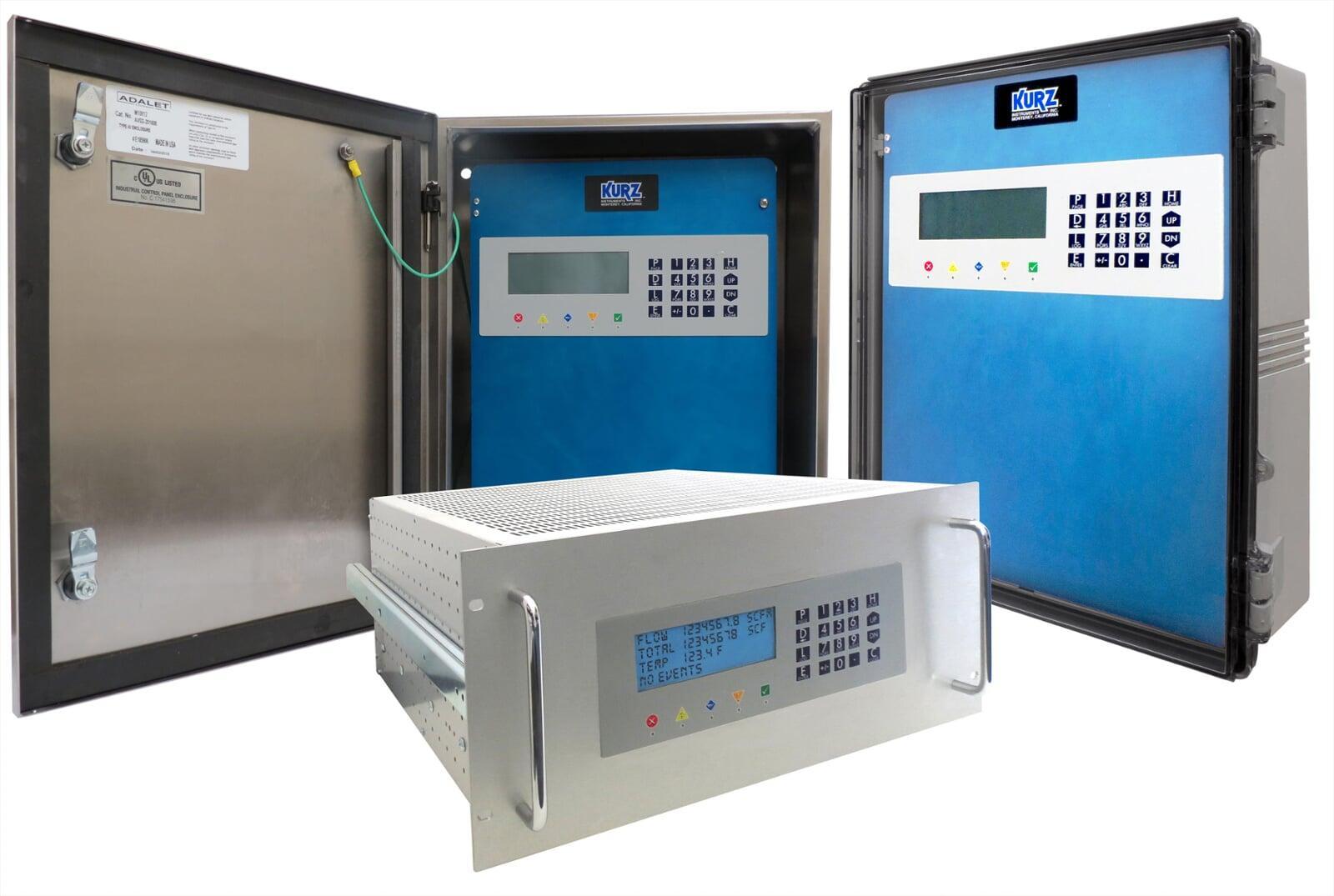
While meters provide raw measurements, mass flow computers transform those readings into actionable, standardized data. By aggregating signals from one or more flow meters, applying temperature and pressure corrections, and normalizing the data, mass flow computers ensure consistency and reliability across different systems and reporting frameworks.
For maintenance managers and engineers responsible for compliance and performance reporting, mass flow computers deliver:
Standardized reporting – align data with regulatory and industry requirements.
Billing and allocation accuracy – ensure precise custody transfer and cost accounting.
Centralized visibility – integrate data from multiple meters into a unified monitoring platform.
Advanced analytics – identify inefficiencies, optimize energy use, and support sustainability initiatives.
Applications
Regulatory compliance – continuous emissions monitoring and reporting for environmental authorities.
Billing and cost allocation – verifying fuel consumption across boilers, turbines, or plant sections.
Energy management – analyzing long-term trends to reduce waste and improve efficiency.
Kurz Mass Flow Computers
Kurz Instruments mass flow computers are designed for industrial reliability, providing seamless integration with their thermal mass flow meters. When paired with single-point or multipoint sensors, they deliver the full picture: precise flow measurement combined with accurate reporting and compliance-ready outputs.

👉 Contact Clipper Controls for expert guidance on selecting the right Kurz Mass Flow Metering solution.

 Toll Free
