Skip to searchSkip to main content

​Real-Time Particulate Monitoring in Water for Injection

Reliable control of particles in WFI is no longer just a compliance checkbox—it’s a lever for reducing batch risk, shortening investigations, and protecting sterile manufacturing capacity. By combining Water for Injection particulate monitoring with dynamic imaging particle analyzer technology from JM Canty, and local integration support from Clipper Controls, facilities can move from intermittent lab tests to true real-time insight into what is happening inside their WFI systems.
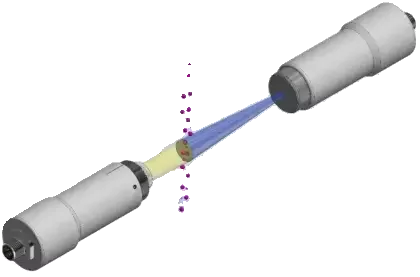
Cutaway illustration of a CANTY InFlow dynamic imaging analyzer measuring particles in a Water for Injection stream

👉  If you’re relying solely on grab samples to manage particles in WFI, it may be time to rethink your strategy. Contact Clipper Controls to explore real-time Water for Injection particulate monitoring options.

​Why Particles in WFI Are a Hidden Business Risk

The cost of foreign particulate in sterile water

For most facilities, particles in WFI are treated as a quality metric. In reality, they are a business risk indicator. Every time foreign particulate is discovered in sterile water or parenteral solutions, it can trigger:
  • Costly batch holds or outright scrapping
  • Time-consuming investigations across production, utilities, and quality
  • Delays in sterile injectable manufacturing schedules
  • Potential product shortages and reputational damage
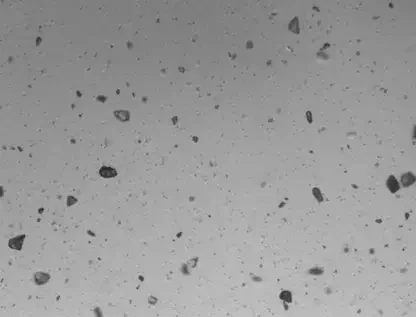
Microscopic grayscale view showing many particles suspended in Water for Injection
Traditional parenteral solutions particulate testing tends to focus on finished product vials. By the time those results show an issue, the damage is already done: WFI has already been used in formulation, equipment prep, or final rinse steps.

A more proactive approach is to treat Water for Injection particulate monitoring as an early warning system. Inline or at-line particle analyzers watching your WFI distribution loop in real time can help you:
  • Detect foreign particulate in WFI before it reaches critical end users
  • Correlate spikes to specific processes (filter changes, maintenance, system upsets)
  • Prevent nonconforming WFI from being used in production steps

In other words, foreign particulate detection in WFI isn’t just about passing a specification—it’s about protecting throughput, minimizing investigations, and keeping sterile injectable manufacturing on schedule.

Regulatory expectations: more than just “pass the test”

Regulators already expect robust pharmaceutical Water for Injection quality control, but many facilities still rely primarily on batch-based testing to show compliance. For particulates, that’s usually USP 788 / 1788 particulate matter testing applied to the final product or grab samples.

Those compendial methods are essential, but they leave gaps when WFI is only checked intermittently:

  • Intermittent visibility – You only see what happened at the moment of the grab sample, not what happened in the hours or days between.
  • Sampling bias – Low, sporadic contamination may be missed entirely if the event doesn’t coincide with a sample.
  • Limited diagnostic value – A failing USP 788 result tells you there’s a problem. It does not tell you where in the WFI system the particles originated or when they appeared.

For facilities asking how to comply with USP 788 particulate limits in sterile water more robustly, the conversation increasingly includes inline particle detection in sterile water and continuous real-time WFI contamination monitoring. When you can trend counts and size distributions directly in the WFI loop, you:
  • Build a stronger, data-backed story around control of particulates
  • Respond faster when excursions occur
  • Support investigations and CAPAs with time-stamped, process-linked evidence

USP methods remain the reference, but inline Water for Injection particulate monitoring strengthens your overall control strategy and helps demonstrate process understanding during inspections.
Clear sterile vial filled with Water for Injection

Why particles in WFI threaten more than just compliance

Beyond regulations, particles in WFI are often an early indicator of deeper problems in the utility system:

  • Upstream equipment wear – Metallic or oxide particles may point to rouge development, pump wear, or valve damage.
  • Biofilm or cleaning issues – Organic or irregular-shaped particles can hint at biofilm shedding or incomplete cleaning, long before traditional microbiological tests show a clear deviation.
  • Filtration and distillation performance shifts – Changes in particle size distribution at the outlet of reverse osmosis, vapor compression distillation, or multiple effect distillation units can indicate fouling or breakthrough.
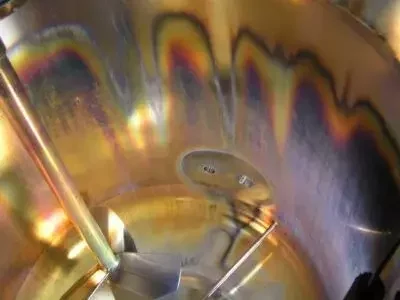
Close-up of rouging on a stainless steel surface inside process piping
Rouge on stainless steel can shed particles into WFI systems if not monitored and controlled.

Treating WFI as a strategic, monitored utility—not just a pass/fail line item—helps operations, maintenance, and quality all pull from the same particle data to make better decisions. Facilities that monitor WFI particulate loads continuously are better positioned to:
  • Protect downstream sterile injectable manufacturing process monitoring efforts
  • Optimize cleaning and maintenance cycles
  • Support capital planning with real data instead of periodic snapshots

With the right technology, pharmaceutical Water for Injection quality control becomes more than just sampling and testing; it becomes a real-time, data-driven tool for reducing risk and protecting revenue.

👉  Interested in seeing what’s really in your Water for Injection, not just a particle count? Call (844) 880-2469 or message us to learn more about how we can help.

​Why Traditional USP 788 Methods Aren’t Enough for WFI Systems

Limitations of light obscuration particle count tests

Light obscuration has been the workhorse for USP 788 / 1788 particulate matter testing, but it was never designed to give operators a clear picture of what’s happening in a live Water for Injection system. It simply counts interruptions in a light beam and assumes each one is a particle.

That creates several limitations for Water for Injection particulate monitoring:
  • It cannot tell the difference between gas bubbles and real particles, so air entrainment or microbubbles can be miscounted.
  • It provides no shape information, which makes it hard to distinguish droplets, fibers, or irregular contaminants.
  • It is sensitive to changes in clarity, refractive index, and sample handling.

When you are trying to manage particles in WFI proactively, these limitations of light obscuration particle count tests mean you are often working with incomplete or misleading data.

Pain points of manual microscopic particle counts

Manual microscopic methods help compensate for some of light obscuration’s blind spots, but they come with their own problems:

  • Labor intensive: A trained analyst must visually scan slides or filters for long periods.
  • Low throughput: Only a limited number of samples can be processed per shift, which discourages frequent monitoring.
  • Sampling and handling risk: Transferring WFI into vials, shipping to the lab, and preparing slides all create opportunities for contamination or particle loss.
  • Inconsistent results: Different analysts may interpret borderline features differently, especially at smaller sizes.

For modern pharmaceutical Water for Injection quality control, relying heavily on manual microscopy slows down response time and pushes particulate understanding into the past instead of keeping it in real time. Facilities are increasingly interested in replacing manual microscopic particle counts with automated imaging that can deliver consistent, auditable results.

Why grab samples can mislead operators

Even when methods are sound, grab samples have a structural weakness: they only capture what was happening at the moment the sample was drawn. In WFI distribution loop monitoring, particulate levels can change quickly due to:

  • Pump starts and stops
  • Valve operations or changeovers
  • Temperature cycles and thermal shocks
  • Upstream filtration, WFI distillation and reverse osmosis filtration monitoring issues

A grab sample taken an hour after a disturbance can look perfectly fine, even if a significant, short-lived foreign particulate event occurred and reached points of use.

For plants asking, “How do we detect particles in Water for Injection inline, not just in occasional samples?”, the answer is continuous or frequent inline and at-line particle analysis. Rather than relying on luck and timing, real-time tools let you see what is actually happening in the WFI loop as conditions change.

​How Dynamic Imaging Transforms Water for Injection Particulate Monitoring

Dynamic imaging vs. light obscuration: what changes for WFI

Traditional light obscuration for WFI simply measures how many times something blocks a light beam and infers a particle count. It can’t tell if that “something” is a solid, a droplet, or a bubble, and it provides no image or shape information. A dynamic imaging particle analyzer like the CANTY InFlow dynamic imaging analyzer takes the opposite approach: it optically magnifies the WFI stream through CANTY fused glass inline flow cell technology and records high-resolution images of each particle as it flows by.

For Water for Injection particulate monitoring, that shift from counting shadows to seeing particles directly means you can:
  • See what light obscuration can only guess at – actual images of particles in flowing WFI instead of anonymous counts.
  • Measure particle size distribution in WFI down to ~1 micron (configuration dependent), using calibrated pixel measurements rather than indirect extinction.
  • Use shape and morphology to classify particles (aspect ratio, roundness, texture), something light obscuration cannot provide.
  • Eliminate ambiguity between particles, droplets, and bubbles, where light obscuration often miscounts entrained gas as “particles.”

In practical terms, light obscuration answers, “How many interruptions did we see?

Dynamic imaging answers, “What exactly is in our WFI, how big is it, and how is it changing over time?”—which is what operations, maintenance, and quality teams actually need to manage risk.
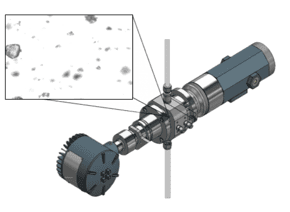
Animated rendering of a CANTY InFlow dynamic imaging analyzer measuring particles in a Water for Injection stream with a magnified view of particle images.
Dynamic imaging “sees” individual particles in flowing WFI, instead of just counting light beam interruptions like traditional light obscuration.
3D model of a CANTY InFlow inline dynamic imaging analyzer with inset showing microscopic images of particles in Water for Injection.
The CANTY InFlow inline analyzer uses a fused-glass flow cell and camera to capture high-resolution particle images for real-time WFI particulate monitoring.

Understanding pixel scale factor and depth of field

Two concepts matter greatly for the accuracy of dynamic imaging particle analyzer systems:

  • Pixel scale factor (PSF): The relationship between pixels in the camera sensor and real-world dimensions in the flow path. A well-calibrated PSF ensures each pixel corresponds to a known micron size, enabling accurate particle sizing across the field of view.
  • Depth of field (DOF): The range in the direction of flow where particles remain in sharp focus. A controlled DOF ensures that particles are neither over- nor under-sized due to being out of focus.

By carefully controlling depth of field and pixel scale factor in dynamic imaging, CANTY InFlow particle analyzer for WFI applications delivers consistent sizing and counting performance, even at very low particle concentrations. That translates to more reliable real-time WFI contamination monitoring and better decision-making.

Discriminating solids, droplets, rouge, biofilm and bubbles

Because dynamic imaging produces detailed, two-dimensional particle images, advanced software such as CantyVision software particle size and shape analysis can classify what you’re seeing, not just how many objects are present.

In Water for Injection particulate monitoring, that enables:

  • Discrimination of gas bubbles in particle analysis, reducing false positives
  • Identification of irregular, organic-like particles that can be indicative of biofilm
  • Characterization of angular or reflective particles that may represent rouge or corrosion products
  • Differentiation between spherical droplets and solid particulates
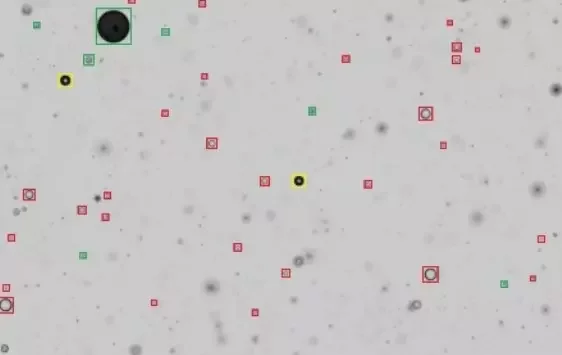
This level of insight gives engineers and quality teams a much clearer picture of what is happening in biopharma purified water and WFI systems and allows faster root-cause analysis when issues arise.
Dynamic imaging microscope frame of WFI with particles highlighted by colored classification boxes
Dynamic imaging software by Canty automatically detects and classifies particles in WFI instead of relying on manual microscopic counts.
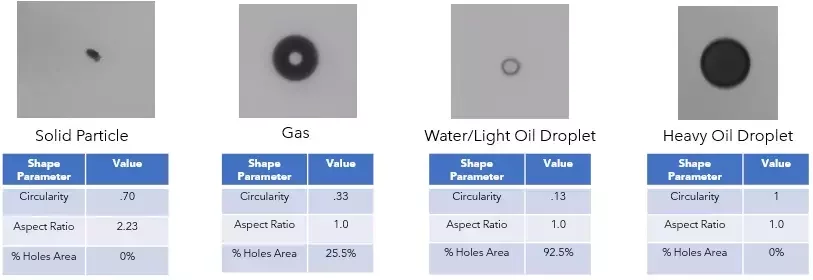
Comparison of solid particle, gas bubble, water or light oil droplet, and heavy oil droplet with corresponding shape parameters
Shape parameters such as circularity, aspect ratio, and hole area allow dynamic imaging to distinguish solids, gas, and droplets in Water for Injection.
Particle Measurement Method Comparison
Method / AttributeLight ObscurationMicroscopeCANTY InFlow Dynamic Imaging
Rouge clarityNo – only sees attenuation, not color/shapeYes* – analyst can visually identify rouge particlesYes – 2D images and shape factors clearly show rouge vs other solids
BubblesError – gas bubbles counted as particlesCan be visually recognized and ignored by analystMeasure – bubbles are detected and classified separately from solids
High viscosity fluidsLimited – performance degrades with increased viscosityPossible but sample prep/handling is slower*Good within design flow range* – image-based, not beam-attenuation based
Sampling requiredYes – off-line grab sample neededYes – off-line sample & slide/filter prepNo – installed inline or at-line; no grab sampling required
Measurement principleLaser light obscuration / extinctionManual microscopic particle countInline dynamic imaging (camera + fused-glass flow cell + image analysis)
Real-time / inline monitoringTypically off-line batch test*No – off-line onlyYes – continuous inline or at-line monitoring of WFI stream
Representative of full WFI streamDepends on grab sample; risk of non-representative dataDepends on grab sample; high risk of sampling biasYes – measures particles as they flow by in real time, no sample vial needed
Gas vs liquid vs solid discriminationNone – all counts look the sameAnalyst can infer types visually*Yes – software classifies solids, rouge, droplets, biofilm, and gas separately
Particle size informationSize bands only; no shape dataApproximate size vs graticule / reference*Full particle size distribution, including counts/mL in USP 788/1788 bands
Image record / traceabilityNo imagesYes, but only if analyst manually captures images*Yes – live and recorded images stored via CantyVision software
Labor requirementModerate – automated instrument but needs sampling, setup, cleaning*High – manual counting, low throughputLow – once installed and configured, analysis and reporting are automatic
Integration to control systemLimited – usually lab instrument, not tightly integrated*None – manual entry into systemsNative integration via VCM: OPC UA, Modbus TCP/IP, Modbus RTU, 4–20 mA outputs
Best suited roleFinal product / QC release testingInvestigative or confirmatory lab workInline WFI monitoring, filtration/distillation performance, rouge/biofilm trending

* Entries marked with an asterisk indicate typical performance or workflow for WFI particle measurement and may differ for specific instruments, methods, or site practices.

​Inline and At-Line Architectures for WFI Distribution and Production

Inline particle detection in sterile water at tank outlets and loops

Inline particle detection in sterile water places the CANTY InFlow inline WFI analyzer directly in the process piping, typically using a sanitary fused-glass sight flow cell. This allows continuous Water for Injection particulate monitoring at critical points such as:
  • WFI process tank outlet monitoring
  • Hot or cold WFI distribution loop monitoring
  • Return lines where rouge, biofilm, or particulate load may shift over time
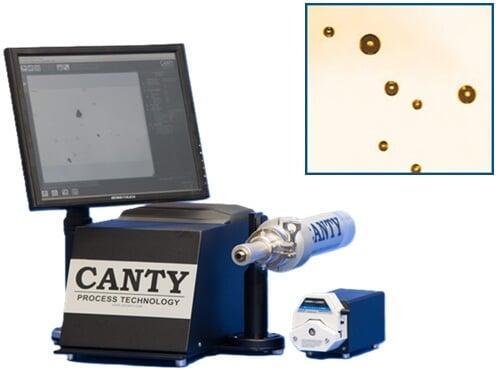
Because the analyzer is installed directly in the line, real-time alarms and trending are possible, turning particles into a true process parameter rather than an occasional lab number.
Bench-top Canty vision system with imaging sensor and monitor displaying particle images
Canty vision systems provide at-line particle imaging for development work, troubleshooting, and validation studies.

Monitoring WFI distillation and reverse osmosis filtration performance

In many facilities, WFI is produced by vapor compression distillation or multiple effect distillation, often following reverse osmosis pre-treatment. A dynamic imaging analyzer can be strategically installed to monitor:
  • Reverse osmosis WFI systems in pharma plants – Detect membrane fouling or breakthrough by tracking changes in particle size and counts.
  • Vapor compression distillation WFI quality control – Confirm that the distillation process is consistently removing particulates.
  • Multiple effect distillation WFI purity monitoring – Spot shifts that may indicate scaling, corrosion, or other process concerns.

With real-time WFI distillation and reverse osmosis filtration monitoring, operations teams can respond quickly to changes instead of waiting for lab results from occasional samples.

At-line, portable and lab-based options

Not every application calls for a permanently installed inline unit. To support flexible monitoring strategies, JM Canty offers:

  • CANTY Mini Lab InFlow laboratory particle analyzer – Ideal for QC labs, pilot plants, and R&D work where WFI and process fluids can be evaluated under controlled conditions with microscopic imaging for process fluids.
  • CANTY Portable InFlow temporary WFI monitoring – A skid-mounted or portable system that can be deployed for projects, validations, or troubleshooting campaigns to get real-time particle data from specific tie-in points without a permanent installation.
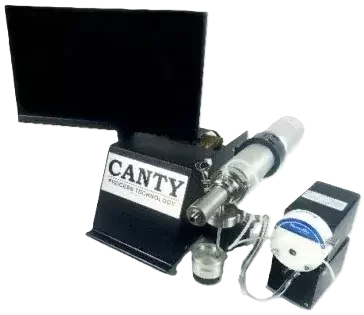
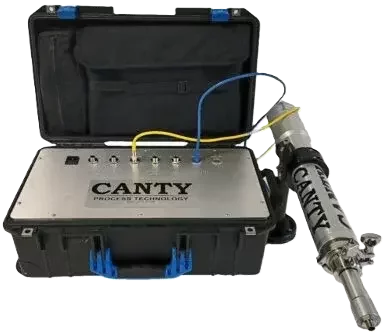
Together, these inline and at-line particle analysis options give you a toolkit for designing the right level of coverage for your plant, from routine monitoring to deep investigations.
CANTY Mini Lab InFlow laboratory dynamic imaging analyzer with integrated microscope and display
CANTY Portable InFlow dynamic imaging analyzer in a rugged case with inline flow cell and cabling

👉  Want your WFI particle data where your operators already work? Ask Clipper Controls how to connect CANTY InFlow analyzers through the Vector Control Module into your existing control and historian platforms.

​From Particles in WFI to Process Decisions: Using Real-Time Data

Real-time WFI contamination monitoring and alarms

Once a CANTY InFlow particle analyzer for WFI is in place, the real value comes from how you use the data. Continuous imaging and counting create a live profile of particles in WFI, including:
  • Counts per mL by size range
  • Particle size distribution trends over time
  • Shifts in particle type (e.g., more metallic vs. organic)

With real-time WFI contamination monitoring, thresholds can be configured to trigger alarms before particulate levels approach critical limits. That makes it possible to:
  • Automatically block WFI supply to critical users when counts exceed setpoints
  • Trigger maintenance inspections or cleaning cycles based on actual data
  • Document how quickly the system returns to baseline after interventions
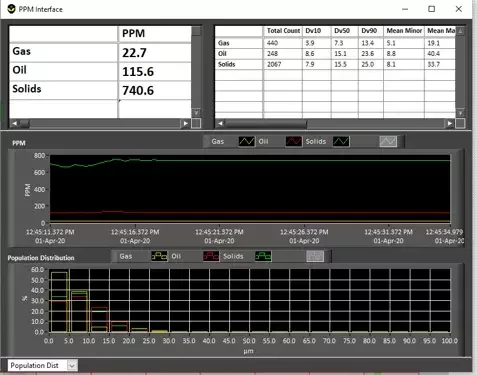
Software dashboard showing real-time PPM readings, trends, and particle population distribution by class
Real-time dashboards display particle concentration and trends so teams can respond quickly to WFI contamination events.

Optimizing WFI filtration and distillation using particle count data

The ability to trend WFI particles day-to-day opens up powerful optimization opportunities:
  • Filter performance: Detect progressive fouling or breakthrough by spotting slow rises in particle counts downstream of filters.
  • Distillation health: Use particle count data to correlate WFI quality changes with feed quality, operating conditions, or maintenance events.
  • Troubleshooting: When you see unexpected excursions, troubleshooting WFI contamination with dynamic imaging analyzers becomes much easier because you can correlate events with operational data in real time.
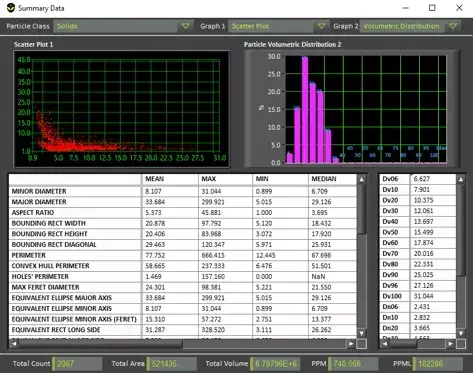
Instead of simply reacting to failed tests, you can adjust setpoints, cleaning frequencies, and operating procedures based on hard, granular data.
Software summary view with scatter plot, histogram of particle size distribution, and detailed particle statistics table
Dynamic imaging software reports full particle size distributions and statistics for deeper WFI process analysis.

De-rouging, cleaning validation, and biofilm monitoring

Many facilities struggle with questions like:

  • “How do we know if our de-rouging was effective?”
  • “Is our cleaning frequency appropriate for this WFI loop?”
  • “Are we seeing early signs of biofilm?”

By tracking specific classes of particles related to metallic rouge or organic/biofilm-like materials, a dynamic imaging system can support:
  • Real-time monitoring of rouge and biofilm in WFI systems
  • Data-driven de-rouging and cleaning validation in WFI lines
  • Before/after comparisons for chemical cleaning campaigns
  • Verification that cleaning has actually stabilized particulate levels
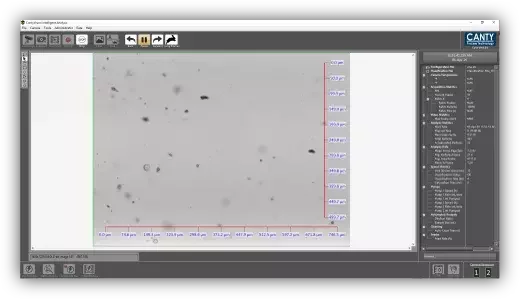
This moves cleaning and de-rouging from calendar-based tasks into evidence-based activities aligned with actual system behavior.
Live imaging software window showing particles in flow with measurement overlays and analysis controls
Operators can review live and recorded images to verify particle classification and investigate WFI events.

CFU, bioburden, and image-based insight for WFI

Microbiological control of Water for Injection is still ultimately expressed as CFU (colony forming units) per milliliter, based on growth on culture media over time. CFU methods remain the regulatory reference for demonstrating that WFI bioburden is under control.

What CANTY InFlow dynamic imaging adds is a fast, image-based way to track micro-sized particles and biofilm-related debris in WFI between those culture-based CFU tests. The same dynamic imaging technology Canty uses for cell count and viability in bioprocess applications can classify and trend very small particles in the WFI stream, giving you an early indication that bioburden or biofilm shedding may be increasing before CFU results are available.

With appropriate method development at your site, InFlow particle classes and size bands can be correlated to CFU trends to create practical alert levels. In day-to-day operation, that means you can:

  • Use real-time particle trends to focus where and when you pull microbiological samples
  • Interpret unexpected CFU excursions in the context of what was happening in the WFI loop at the time
  • Treat image-based measurements as an early warning tool for bioburden and biofilm, while CFU plate counts remain your formal release test


This combination of real-time dynamic imaging plus periodic CFU testing gives quality and microbiology teams a much richer picture of WFI health than relying on culture data alone.

​Connectivity, Data Integration, and Compliance Documentation

CANTY Vector Control Module (VCM) connectivity

The CANTY Vector Control Module VCM connectivity platform is designed to make inline Water for Injection particulate monitoring data easy to integrate into your control and information systems. Depending on your needs, VCM can provide:
  • OPC UA for modern DCS and SCADA platforms
  • Modbus TCP/IP or Modbus RTU for legacy systems
  • 4–20 mA outputs for simple thresholds or trending
  • Digital alarms for high particle load events
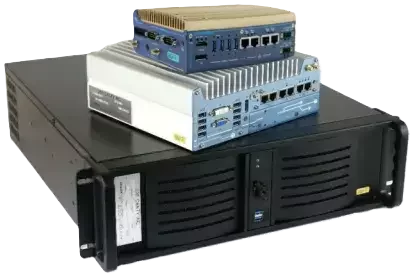
This lets you embed real-time WFI contamination monitoring directly into your existing automation infrastructure.
Stack of industrial computer modules used as the Canty Vector Control Module for data acquisition and connectivity
The Vector Control Module connects CANTY InFlow analyzers to plant control systems, historians, and MES for WFI particulate monitoring.

Integrating WFI particle data into plant historians and MES

With open connectivity, CANTY InFlow dynamic imaging analyzer data can be sent to:

  • Plant historians for long-term storage and trending
  • MES and batch records for contextualizing particulate events in production runs
  • Data analytics platforms for advanced visualization and correlation

Bringing inline Water for Injection particulate monitoring data together with TOC, conductivity, temperature, and flow gives a much more complete picture of your biopharma purified water and WFI systems.

Supporting audit trails and data integrity

When particle data is captured and time-stamped in a historian or MES, it becomes part of your data integrity and audit trail strategy. That supports:

  • Faster investigations and CAPAs when particulate issues arise
  • Clear documentation of system control for inspections
  • Demonstrable evidence that inline particle detection in sterile water is part of your quality strategy, not just a “nice to have”

While this does not replace your required USP 788 / 1788 particulate matter testing, it strengthens your overall story of control and process understanding.

​Choosing the Right CANTY InFlow Configuration for Your WFI System

New WFI system design and greenfield projects

For new installations, you have the opportunity to design JM Canty Water for Injection particle monitoring solutions into the system from day one. Typical strategies include:
  • Inline analyzers at key stages of reverse osmosis WFI systems in pharma plants
  • Monitoring at the discharge of vapor compression distillation or multiple effect distillation units
  • WFI process tank outlet monitoring to protect the distribution loop and end users

By integrating CANTY InFlow inline WFI analyzer units early, you can ensure clean hygienic design, appropriate sample velocities, and optimal accessibility for maintenance.

Retrofitting existing purified water and WFI systems

Many sites need to enhance pharmaceutical Water for Injection quality control on existing systems. In these cases, Clipper Controls can help identify:

  • Suitable tie-in locations for inline fused-glass flow cells
  • Where inline particle detection in sterile water is practical vs. where at-line or portable setups make more sense
  • How to stage investments, starting with high-risk locations and expanding coverage over time

Retrofits often combine permanent inline analyzers at critical points with CANTY Portable InFlow temporary WFI monitoring to support projects, validation work, and troubleshooting.

Lab, validation, and troubleshooting scenarios

The CANTY Mini Lab InFlow laboratory particle analyzer is well-suited for:

  • Qualification and optimization of new filtration or WFI generation steps
  • Detailed examination of particles in WFI retrieved from specific parts of the system
  • Validation studies comparing dynamic imaging results to traditional methods

For acute problems or suspected contamination, portable and lab-based analyzers let teams rapidly investigate, visualize, and quantify particulates without waiting on outside services.

​Business Case: Why Dynamic Imaging Delivers More Value Than Light Obscuration for WFI

Reducing batch risk and investigation time

Traditional parenteral solutions particulate testing catches problems late—often after product has been filled, packaged, or staged for release. Inline dynamic imaging moves the detection point upstream, closer to the utility that feeds many processes.

Benefits include:
  • Lower risk of surprise particulate findings in finished product
  • Shorter, more focused investigations, using time-stamped WFI data
  • Stronger linkage between Water for Injection particulate monitoring and process events

This directly translates into reduced batch risk and less time diverted to reactive problem solving.

Lowering manual sampling and lab workload

With continuous or high-frequency automated monitoring, you can strategically reduce reliance on manual sampling and testing:

  • Fewer grab samples required solely to “check in” on WFI particulate levels
  • Less analyst time spent on manual microscopic particle counts
  • More consistent data from automated dynamic imaging particle analyzer systems

That doesn’t eliminate the need for compendial methods, but it does let you reserve them for their intended purposes, while daily control is handled by automated, inline tools.

Extending equipment life and optimizing maintenance

Over-cleaning and over-maintaining WFI systems can be just as costly as doing too little. With real-time monitoring of rouge and biofilm in WFI systems, you can:

  • Identify when rouge or biofilm is beginning to develop
  • Plan de-rouging and cleaning validation in WFI lines based on real evidence instead of fixed calendar intervals
  • Track improvements or deterioration over time and link them to operating conditions
This supports extending equipment life where appropriate, focusing capital and maintenance budgets where they matter most.
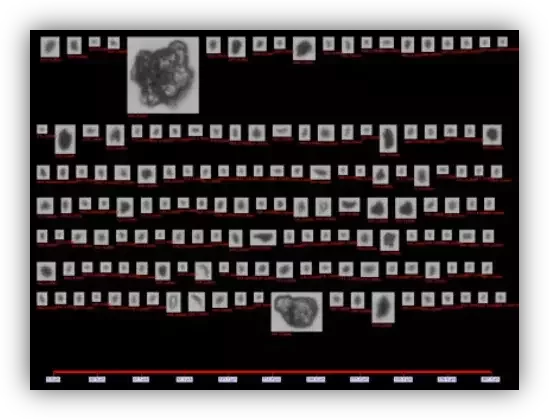
Dynamic imaging software screen showing multiple solid particle images in Water for Injection sorted by size and shape.
Dynamic imaging groups solid particles so teams can quickly see what contaminants are present in WFI and how they change over time.
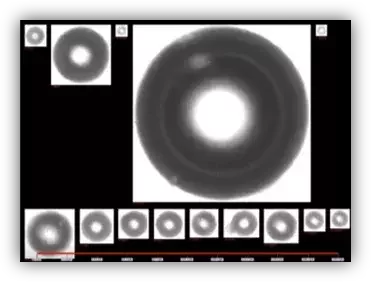
Dynamic imaging view highlighting ring-shaped gas bubble images automatically identified in Water for Injection.
Gas bubbles are identified and classified separately, reducing false particle counts that commonly affect light obscuration measurements.
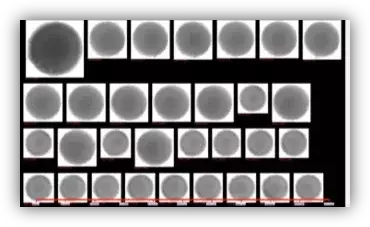
Dynamic imaging display showing spherical liquid droplets detected and organized by size in a Water for Injection sample.
Droplets are clearly distinguished from solid particles, helping engineers understand whether a WFI event is related to process conditions or true contamination.

Summarizing the value: benefits of dynamic imaging over light obscuration for WFI

In short, the benefits of dynamic imaging over light obscuration for WFI include:

  • Real images, not just counts
  • Inline, real-time insight instead of periodic snapshots
  • Classification of bubbles, droplets, solids, rouge, and biofilm-related particles
  • Integration with plant data systems for richer diagnostics and reporting
  • Reduced manual workload and faster investigations

​Partnering with Clipper Controls and JM Canty for WFI Quality Control

Local expertise plus specialized technology

JM Canty provides the specialized CANTY InFlow dynamic imaging analyzer technology and JM Canty Water for Injection particle monitoring solutions. Clipper Controls brings:
  • Local application engineering and system integration experience
  • Knowledge of sterile injectable manufacturing process monitoring needs
  • Familiarity with biopharma purified water and WFI systems from generation through distribution

Together, we help you design, install, and support a practical, value-focused Water for Injection particulate monitoring strategy.
Clipper Controls technical specialist assisting customers with dynamic imaging solutions

From site assessment to commissioning and training

A typical engagement can include:

  • WFI and purified water system review
  • Identification of high-risk points and monitoring priorities
  • Selection of inline, at-line, portable, and lab analyzers
  • Integration planning using CANTY Vector Control Module VCM connectivity
  • Commissioning support and operator training

This ensures that CANTY InFlow inline WFI analyzer systems become a trusted part of your operations, not just another instrument.

Next steps: evaluate your particles-in-WFI risk

If you are seeing unexplained particulate findings or relying heavily on intermittent testing, now is a good time to ask:

  • Are we only testing WFI in the lab, or do we have inline particle detection in sterile water where it matters most?
  • Do we understand what our particles are (rouge, biofilm, bubbles, droplets), or just that they exceed a limit?
  • Could we reduce investigation time and batch risk with better real-time visibility?
  • Dynamic imaging offers a clear path forward—from sporadic snapshots to continuous understanding of particles in WFI.

👉 Ready to quantify the ROI of moving beyond light obscuration for WFI?
Message Clipper Controls or call us at (844) 880-2469 to review your current particulate testing strategy and explore the value of dynamic imaging.


Clipper Controls Logo
JM Canty Logo

​Frequently Asked Questions

What is Water for Injection particulate monitoring?

Water for Injection particulate monitoring is the real-time measurement of particles in WFI as it’s generated, stored, and distributed. It helps pharmaceutical plants detect particles in WFI before they reach critical processes, reducing batch risk and supporting stronger Water for Injection quality control.

How is dynamic imaging different from light obscuration for WFI?

Light obscuration only counts interruptions in a light beam, while dynamic imaging captures actual images of particles in WFI. A CANTY InFlow dynamic imaging particle analyzer measures particle size distribution, shape, and type, helping distinguish droplets, gas bubbles, rouge, and biofilm in Water for Injection.

Does real-time dynamic imaging replace USP 788 / 1788 particulate matter testing?

No, real-time dynamic imaging does not replace USP 788 / 1788 particulate matter testing; it complements it. Inline Water for Injection particulate monitoring provides continuous data between grab samples, supporting compliance, faster investigations, and better documentation for pharmaceutical facilities.

Where should I install an inline WFI particle analyzer?

Inline particle detection in sterile water is typically installed at the WFI process tank outlet, in the WFI distribution loop, or at key filtration and distillation outlets. Clipper Controls can help identify the best locations for CANTY InFlow inline WFI analyzers based on your purified water and WFI system layout.

How does CANTY InFlow connect to my control system and historian?

CANTY InFlow is usually paired with the CANTY Vector Control Module, which provides OPC UA, Modbus, and 4–20 mA outputs. This lets you integrate Water for Injection particulate monitoring data into your existing DCS, PLC, SCADA, and historian so operators on the West Coast and beyond can trend particles in WFI alongside TOC, conductivity, and flow.