Skip to searchSkip to main content

​UV Absorption Analyzers

UV absorption (UV photometric) analyzers measure ozone (O₃) by passing 254 nm UV light through a sample cell and applying the Beer–Lambert law.

Whether you’re building an ambient air monitoring program, verifying ozone in a treatment system, or protecting a process area with ozone safety monitoring, UV absorption remains a widely used, field-proven method.

👉 We support customers across California, Nevada, and Hawaii with application help, startup/commissioning guidance, and the right analyzer selection for your range, environment, and reporting needs. Contact us today!
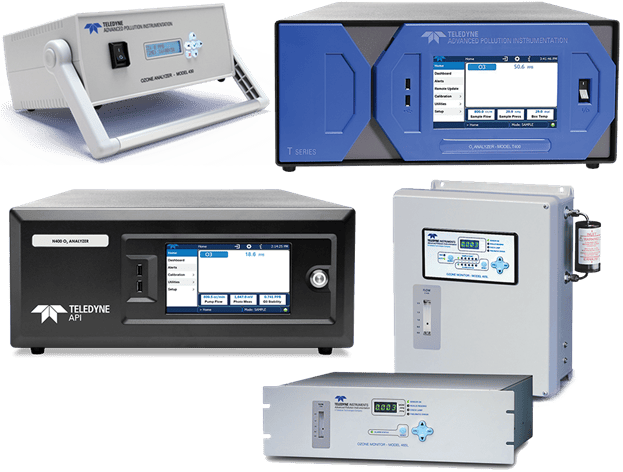

Product lineup image of Teledyne API UV absorption ozone analyzers: Models 430, 465L, N400, and T400.
Teledyne API Logo

​What a UV Absorption Analyzer Measures (and what it doesn’t)

Measures: In gas monitoring, “UV absorption analyzer” almost always means a UV photometric analyzer that measures ozone (O₃).

Not For: It’s not a catch-all UV instrument, and it’s not the same as UV absorption in liquids (like UVT-254 / spectral absorption probes) used for water-quality monitoring. Those instruments measure UV absorption/transmittance in water, not ozone concentration in air.

​How UV Absorption Ozone Measurement Works

A UV absorption ozone analyzer typically:

  • Sends 254 nm UV light through a measurement cell
  • Measures transmitted light and applies Beer–Lambert law to calculate ozone concentration
  • Uses a cycle (often involving an ozone-scrubbed reference) to improve stability and reduce drift 
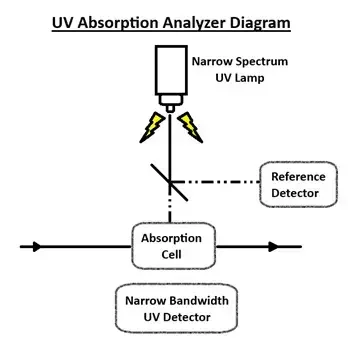
Why 254 nm? Ozone strongly absorbs UV at this wavelength, enabling sensitive measurements from low ppb ranges up through higher process ranges (instrument-dependent).
UV absorption analyzer schematic showing a narrow-spectrum UV lamp sending light through an absorption cell to a narrow-bandwidth UV detector, with a reference detector for lamp intensity correction.
Simplified UV absorption analyzer layout: UV lamp → absorption cell → UV detector, with a reference detector to compensate for lamp output changes.

​Where UV Absorption Analyzers are Used

Common applications we see in CA/NV/HI include:
  • Ambient air monitoring (regulatory and research networks)
  • Industrial safety around ozone generation or ozone-contact systems
  • Process ozone monitoring (off-gas or higher concentration ranges)
  • Water treatment ozone systems (paired with gas- or dissolved-ozone measurement, depending on the process)

For regulatory monitoring programs, it may be important to align with designated method configurations and QA expectations.
Bright white cumulus clouds against a blue sky with light haze.

​What to Specify When You Request a Quote

To get the right UV absorption analyzer (and avoid surprise rework), identify these upfront:
  • Measurement range & units
    • Ambient monitoring is typically low-level (ppb)
    • Safety/process may be ppm to higher ranges (depends on ozone system design)
  • Sample conditions 
    • Humidity/condensation risk, particulates, corrosives, temperature swings 
    • Sample conditioning and filtration requirements
  • Interferences & environment 
    • Nearby VOCs/solvents, high humidity, or unusual gas matrices can impact measurement performance 
    • If the environment is challenging, we can help confirm suitability and options
  • Data + integration 
    • Outputs needed (analog, serial, ethernet), averaging times, and how it ties into SCADA/DAQ
  • Calibration & QA expectations 
    • Traceability requirements, audit expectations, and site/network SOPs

​Teledyne API UV Absorption Analyzer Options

For U.S. ambient programs, ozone measurement methods are defined in 40 CFR Part 50, Appendix D, so configuration, QA, and documentation matter.

Teledyne API offers a strong portfolio of ozone analyzers and air monitoring instrumentation, including UV absorption models for ambient monitoring, portable measurement, and safety/process applications.

​Ambient Ozone (UV Absorption)

Teledyne API T400 (UV Absorption O₃ Analyzer)
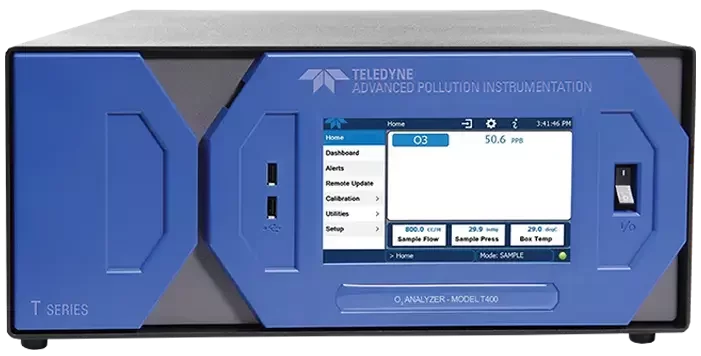
Built for ambient air monitoring where long-term stability and repeatable QA routines matter. The T400 uses UV photometric (UV absorption) measurement at 254 nm with periodic ozone-scrubbed reference switching to help deliver a stable, “true” ozone reading over time. It’s a strong fit for fixed monitoring stations, network deployments, and applications where data continuity and auditability are priorities.

Best for: ambient monitoring sites, fixed stations, long-duration monitoring programs

Ask us about: reporting/data needs, sample conditioning, siting considerations, QA/QC workflow

Teledyne API T400 UV absorption ozone analyzer (T-Series) with touchscreen front panel.

Teledyne API N400 (UV Absorption O₃ Analyzer)
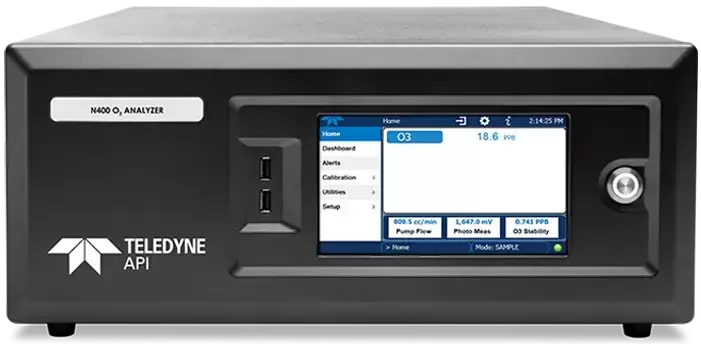
The N400 is an ambient-focused UV absorption ozone analyzer designed for reliable low-range ozone measurement with modern usability features like continuous self-checking and customizable alerts. Choose the N400 when you want a fixed, network-ready ambient ozone platform that supports day-to-day operations with strong diagnostics and straightforward configuration—especially in environments where temperature swings and uptime expectations are real-world concerns.

Best for: ambient air networks, remote stations needing robust diagnostics, long-term deployments

Ask us about: alarm/notification strategy, comms and integration, maintenance intervals, station setup

Teledyne API N400 UV absorption ozone analyzer with color display front panel.

​Portable Ozone Monitoring

Teledyne API 430 (Portable O₃ Monitor)
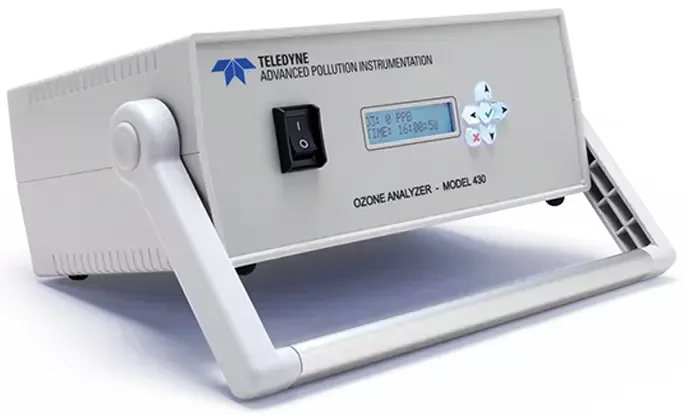
Need ozone measurements in the field? The 430 is a compact UV absorption ozone monitor designed for portability without giving up measurement credibility. It’s a practical choice for surveys, short-term studies, troubleshooting, indoor/IAQ investigations, and temporary deployments—anywhere you need to move fast, set up quickly, and capture trustworthy ozone readings outside a permanent station.

Best for: mobile surveys, temporary monitoring, troubleshooting, research/short studies

Ask us about: deployment method, power approach, sampling setup, transport/field workflow

Teledyne API 430 portable UV absorption ozone monitor with angled bench stand and LCD display.

​Safety / Process Ozone Monitoring

Teledyne API 465L (UV Photometric Ozone Monitor)
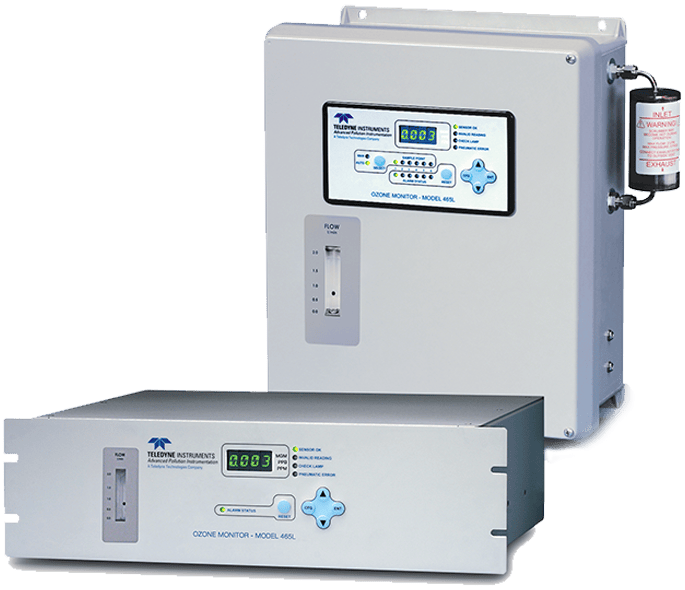
The 465L is purpose-built for safety and process ozone monitoring in industrial environments. It’s designed for stability at low-level ppm conditions and includes pressure and temperature compensation to maintain accuracy under changing conditions. If your application needs alarms, diagnostics, and reliable continuous monitoring—often with rugged mounting options and the ability to monitor multiple sample points—this is the workhorse to look at.

Best for: ozone safety monitoring, process-area monitoring, industrial hygiene, multiple sampling points

Ask us about: alarm setpoints/contacts, enclosure/mounting needs, sample locations, integration to PLC/SCADA

Teledyne API 465L UV photometric ozone monitor shown in wall-mount enclosure and rack-mount configurations.

👉 Not sure which Teledyne API model fits? Message us with your target range, sample conditions, and whether this is ambient, safety, or process monitoring—and we’ll steer you to the right platform and accessories.

​Talk to a UV Absorption Analyzer Specialist
Clipper Controls helps customers across California, Nevada, and Hawaii select, specify, and deploy ozone analyzers and air monitoring instrumentation.

Clipper Controls Logo
Teledyne API Logo

​FAQ

What is a UV absorption analyzer?

In air monitoring, it most often means a UV photometric ozone analyzer that determines O₃ concentration by measuring UV light absorption at 254 nm and applying Beer–Lambert law.

Why do ozone analyzers use 254 nm UV light?

Ozone absorbs strongly at 254 nm, which enables sensitive and stable ozone measurement when paired with a known optical path and proper calibration approach.

Is “UV absorption analyzer” the same as UVT-254 water probes?

No. UVT-254/SAC probes measure UV transmittance/absorption in liquids for correlated water-quality parameters. Ambient ozone analyzers are gas-phase photometric instruments.

How do I choose between ambient vs. safety/process ozone analyzers?

It comes down to range, sample handling, and installation environment. Ambient analyzers prioritize low-level accuracy, while safety/process monitors are selected for ppm+ ranges and harsher conditions.

Are UV absorption ozone analyzers used in regulatory monitoring?

They can be used in regulatory programs when configured and operated to match program requirements, QA procedures, and any applicable designated method expectations.